Start with words that help you answer a question, find a place and name things around you. These 32 entries give you a small, useful vocabulary to return to throughout the day.
This guide uses Modern Standard Arabic (MSA), the variety used in much written Arabic and formal speech. Everyday conversation varies by region, so these are not presented as the local expressions for every Arabic-speaking country.
How to use the reading aids
Read the Arabic first, then check the meaning. aa, ee, oo mark long vowels; ʿ represents ع and ʾ represents ء. ḥ is ح, gh is غ, kh is خ and ṭ is ط. dh sounds roughly like “th” in “this.” These aids are approximate, not a substitute for listening.
Nouns below are vocabulary forms without grammatical case endings. A final ة is read as -a here; its pronunciation can change in connected speech. Conventional expressions such as شُكْرًا keep their usual form.
Answer and introduce yourself
| Arabic | Reading aid | Meaning |
|---|---|---|
| مَرْحَبًا | marḥaban | hello |
| شُكْرًا | shukran | thank you |
| نَعَم | naʿam | yes |
| لَا | laa | no |
| أَنَا | anaa | I |
| أَنْتَ / أَنْتِ | anta / anti | you, addressing one male / one female |
The two forms of “you” depend on the person you are addressing, not the person speaking. لَا is useful as an answer, but it cannot replace every English “not” in a sentence.
Ask a question or point something out
| Arabic | Reading aid | Meaning |
|---|---|---|
| مَنْ | man | who |
| مَا | maa | what |
| أَيْنَ | ayna | where |
| مَتَى | mataa | when |
| كَيْفَ | kayfa | how |
| هَذَا | haadhaa | this, with a masculine singular noun |
| هَذِهِ | haadhihi | this, with a feminine singular noun |
مَا means “what” in questions such as مَا هَذَا؟, “What is this?” It has other functions too, so do not assign it one English meaning everywhere you see it.
Things and places around you
| Arabic | Reading aid | Meaning |
|---|---|---|
| بَيْت | bayt | house; home |
| غُرْفَة | ghurfa | room |
| بَاب | baab | door |
| كِتَاب | kitaab | book |
| قَلَم | qalam | pen; pencil, depending on context |
| مِفْتَاح | miftaaḥ | key |
| مَدْرَسَة | madrasa | school |
| سُوق | sooq | market |
A noun may appear with الـ, the definite article, attached: بَاب → الْبَاب. Learn to recognise the word inside that longer form. Arabic nouns have grammatical gender: بَاب is masculine and غُرْفَة is feminine.
Place, time and connection
| Arabic | Reading aid | Meaning |
|---|---|---|
| هُنَا | hunaa | here |
| هُنَاكَ | hunaaka | there |
| الْيَوْم | al-yawm | today |
| الْآن | al-aan | now |
| غَدًا | ghadan | tomorrow |
| فِي | fee | in |
| وَ | wa | and |
وَ attaches to the next word in writing: كِتَاب وَقَلَم, “a book and a pen.” It is counted as one vocabulary entry here even though it is not usually written as a separate word.
Four useful food and drink words
| Arabic | Reading aid | Meaning |
|---|---|---|
| مَاء | maaʾ | water |
| شَاي | shaay | tea |
| خُبْز | khubz | bread |
| طَعَام | ṭaʿaam | food |
Put a few words together
These brief MSA examples omit noun case endings for first reading practice.
أَيْنَ الْمِفْتَاح؟
ayna al-miftaaḥ? Where is the key?
الْمِفْتَاح هُنَا.
al-miftaaḥ hunaa. The key is here.
هَذِهِ غُرْفَة.
haadhihi ghurfa. This is a room.
Notice that the last two examples have no separate word corresponding to English “is.” Do not insert one automatically in this kind of present-tense sentence.
A five-minute practice
- Find the words for “where,” “when” and “how” without using the reading aids.
- Choose هَذَا or هَذِهِ before غُرْفَة.
- Read الْمِفْتَاح هُنَا and explain its meaning.
- What does غَدًا mean?
- Point to three things you can name in Arabic. If none is nearby, write their names instead.
Answers: 1. أَيْنَ، مَتَى، كَيْفَ. 2. هَذِهِ. 3. The key is here. 4. Tomorrow. Your last answer can vary.
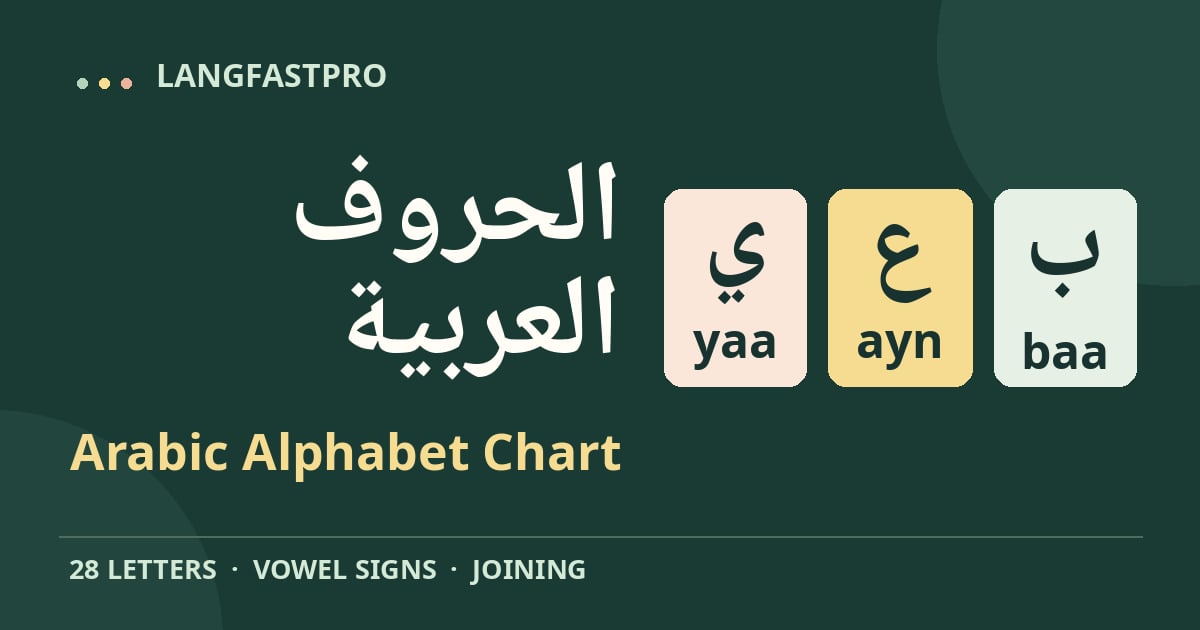
For help with the letters, use the Arabic alphabet guide. To develop these short examples, continue with Arabic sentences and Arabic nouns and adjectives.
Sources and further reading
The explanations and practice are original, not translations of source lessons. Native-language guidance comes from Al Jazeera Learning's demonstratives lesson, question words lesson and time/place reference, alongside an independent Al-Mustansiriyah University reference on demonstratives. These support the grammar distinctions, not a claim that every entry was drawn from one source. UC Davis's Arabic Without Walls provides supplementary learner vocabulary.