शब्दों को जोड़कर हिंदी सीखें।
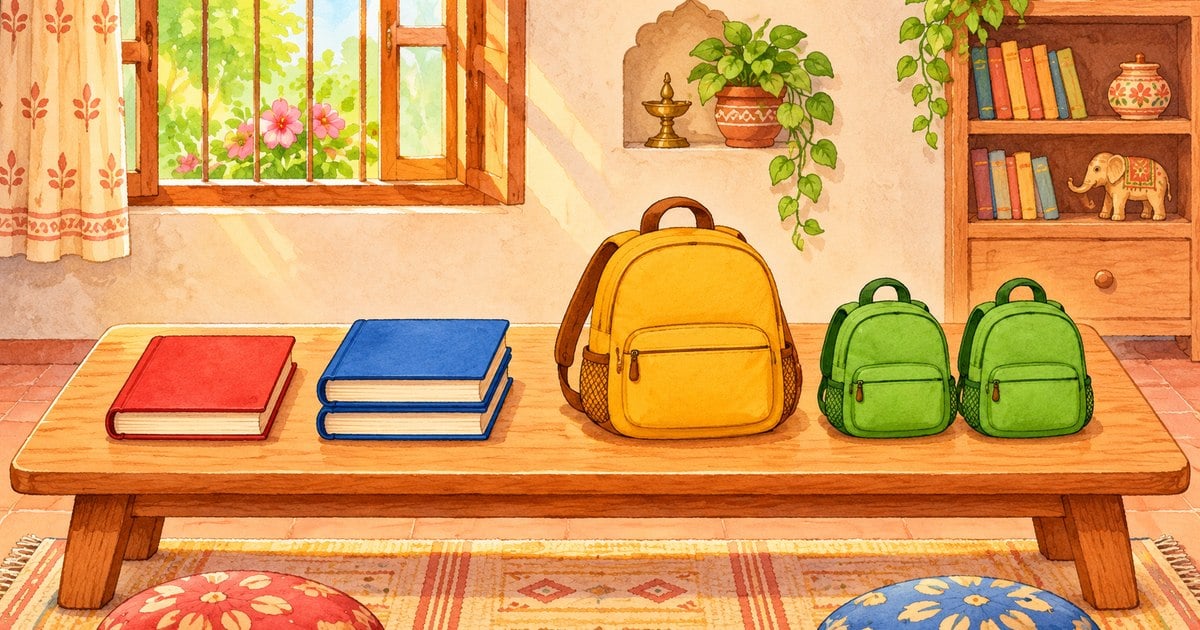
Put a book beside a bag. In Hindi, you can say मेरी किताब (meree kitaab, my book) but मेरा बैग (mera baig, my bag).
Why did “my” change? The owner stayed the same. The noun changed. That small discovery connects three useful parts of Hindi grammar: noun gender, plurals and possession.
By the end of this lesson, you will be able to name a few things around you, say which ones are yours and turn one into more than one. If you are new to whole sentences, start with Your First Hindi Sentences.
1. Learn a noun with a useful partner
Hindi nouns have grammatical gender: masculine or feminine. For people and animals, gender sometimes follows the person or animal being described. For a book, a room or a flower, grammatical gender is simply part of the word.
| Hindi noun | Reading aid | Meaning | Gender | Learn it in a phrase |
|---|---|---|---|---|
| कमरा | kamra | room | Masculine | मेरा कमरा, mera kamra, my room |
| बैग | baig | bag | Masculine | मेरा बैग, mera baig, my bag |
| फूल | phool | flower | Masculine | मेरा फूल, mera phool, my flower |
| किताब | kitaab | book | Feminine | मेरी किताब, meree kitaab, my book |
| कुर्सी | kursee | chair | Feminine | मेरी कुर्सी, meree kursee, my chair |
| चाबी | chaabee | key | Feminine | मेरी चाबी, meree chaabee, my key |
Instead of memorising “kitaab: feminine” in isolation, repeat मेरी किताब while holding a book. The phrase gives you a small piece of grammar you can use immediately.
Many nouns ending in -आ are masculine and many ending in -ई are feminine, but this is a clue, not a test that always works. पानी (paanee, water) is masculine. When learning a new noun, check its gender rather than guessing from its last letter.
The reading aids use ee and oo for long i/u sounds. Long a is usually aa, though familiar endings such as mera and ka keep a single a. They keep the spelling simple and do not represent every Hindi sound. In plural forms such as kitaaben, the final n reminds you of a nasal vowel.
2. Turn one into several
Start with nouns used directly in simple sentences, without a following word such as “in,” “on” or “to.” Those other constructions can require different forms.
| One | More than one | What to notice |
|---|---|---|
| कमरा, kamra | कमरे, kamre | Many masculine -aa nouns change to -e |
| बच्चा, bachcha | बच्चे, bachche | The same common pattern |
| फूल, phool | फूल, phool | Many other masculine nouns stay the same |
| किताब, kitaab | किताबें, kitaaben | Many feminine consonant-ending nouns add -en |
| कुर्सी, kursee | कुर्सियाँ, kursiyaan | Feminine -ee becomes -iyaan |
| चाबी, chaabee | चाबियाँ, chaabiyaan | Learn the whole plural with its noun |
Now give the nouns a sentence:
यह कमरा है।
Yah kamra hai.
This is a room.
ये कमरे हैं।
Ye kamre hain.
These are rooms.
यह फूल है।
Yah phool hai.
This is a flower.
ये फूल हैं।
Ye phool hain.
These are flowers.
The word फूल did not change, but यह / ये and है / हैं show the difference. Do not add an ending to every noun just because the English word has an s.
There are exceptions to the patterns: पिता (pita, father) does not become pite in the direct plural. Learn the small table first, then add exceptions as you meet them.
3. Make “my” match the thing
For the simple direct phrases in this lesson:
| Thing described | “My” | Example |
|---|---|---|
| Masculine singular | मेरा, mera | मेरा कमरा, my room |
| Masculine plural | मेरे, mere | मेरे कमरे, my rooms |
| Feminine singular | मेरी, meree | मेरी किताब, my book |
| Feminine plural | मेरी, meree | मेरी किताबें, my books |
Both a man and a woman can say मेरी किताब. Both can say मेरा कमरा. The choice follows the noun, not the speaker's gender.
मेरी किताब यहाँ है।
Meree kitaab yahaan hai.
My book is here.
मेरी किताबें यहाँ हैं।
Meree kitaaben yahaan hain.
My books are here.
मेरे कमरे छोटे हैं।
Mere kamre chhote hain.
My rooms are small.
What about “your”?
With respectful आप, use आपका / आपके / आपकी in the same three slots:
- आपका बैग (aapka baig): your bag.
- आपके बैग (aapke baig): your bags.
- आपकी किताब (aapkee kitaab): your book.
- आपकी किताबें (aapkee kitaaben): your books.
You can now ask क्या यह आपकी किताब है? Kya yah aapkee kitaab hai? Is this your book?
4. Say whose it is with का, के and की
English can add an apostrophe: Meena's book. Hindi puts a linking word after the owner's name.
| Hindi | Reading aid | Meaning |
|---|---|---|
| मीना का बैग | Meena ka baig | Meena's bag |
| मीना के बैग | Meena ke baig | Meena's bags |
| मीना की किताब | Meena kee kitaab | Meena's book |
| रवि की किताबें | Ravi kee kitaaben | Ravi's books |
Again, look at the thing that follows the linking word. की goes with किताब or किताबें whether the owner is Meena or Ravi.
This table uses names to keep the pattern clear. When the owner is another noun, that noun can change too: बच्चे की किताब (bachche kee kitaab) means “the child's book.” That is a case change, not evidence of several children. You will meet more of these forms when learning postpositions.
5. Add a description
Some adjectives also match their nouns. Try छोटा (chhota, small):
- छोटा कमरा (chhota kamra): a small room.
- छोटे कमरे (chhote kamre): small rooms.
- छोटी किताब (chhotee kitaab): a small book.
- छोटी किताबें (chhotee kitaaben): small books.
Other adjectives do not change in these patterns. साफ़ (saaf, clean) stays the same in साफ़ कमरा and साफ़ किताब.
You do not need to change every describing word. Learn a new adjective in two examples, one masculine and one feminine, so you can see which kind it is.
6. A useful “I have” pattern
For an object in your possession, try मेरे पास … है / हैं:
मेरे पास एक किताब है।
Mere paas ek kitaab hai.
I have a book.
मेरे पास दो किताबें हैं।
Mere paas do kitaaben hain.
I have two books.
The phrase मेरे पास stays the same here. Choose है or हैं for the item or items. Do not change it to meree paas because किताब is feminine.
This is a useful object-possession pattern, not a universal replacement for English “have.” Family relationships use a different construction: मेरी एक बहन है। Meree ek bahan hai. I have one sister.
Look around and practise
Use real objects if you can. A room, a book and a chair are enough.
- Say “my book” and “my books.”
- Change मेरा कमरा to “my rooms.”
- Complete: रवि ___ किताब यहाँ है।
- Say “I have two books.”
- Choose: छोटी किताबें or छोटे किताबें.
- Does फूल need a new ending in ये ___ हैं।?
Answers
- मेरी किताब; मेरी किताबें. Meree kitaab; meree kitaaben.
- मेरे कमरे. Mere kamre.
- की: रवि की किताब यहाँ है। Ravi kee kitaab yahaan hai.
- मेरे पास दो किताबें हैं। Mere paas do kitaaben hain.
- छोटी किताबें. Chhotee kitaaben. किताबें is feminine plural.
- No. ये फूल हैं। Ye phool hain. These are flowers.
Keep practising with these Hindi lessons:
Grammar references: Basic Hindi: Gender and Number, Michigan State University Libraries, possessive forms in Basic Hindi, and Rupert Snell's Hindi Skeleton Grammar. Explanations, examples and practice are newly written for LangFastPro.