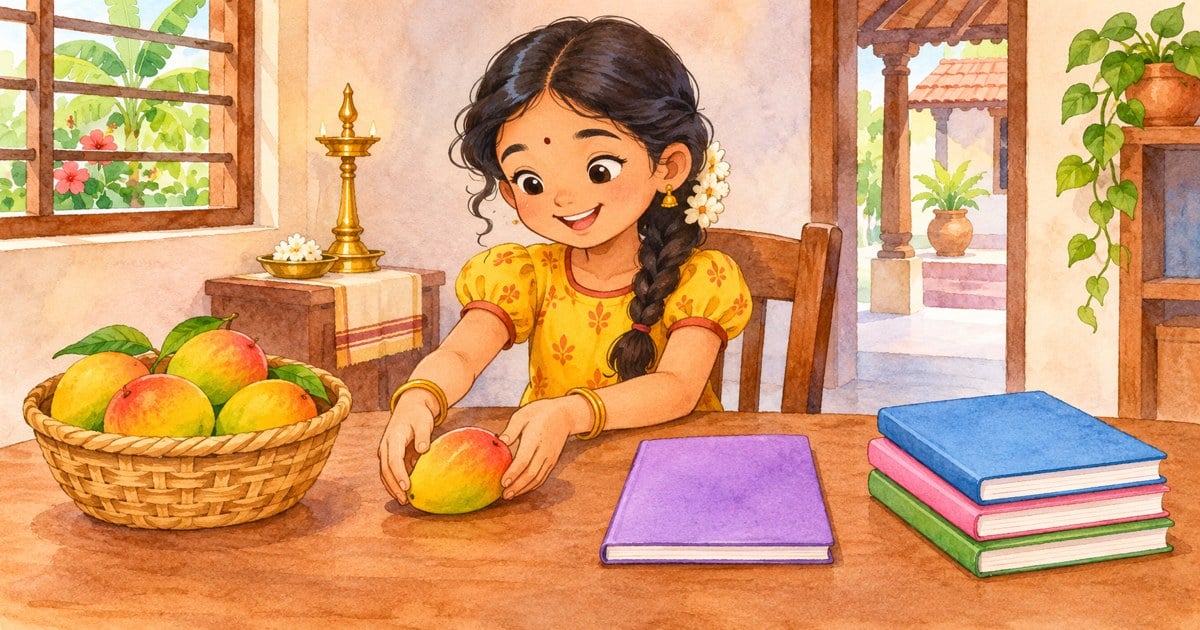
చిన్న వాక్యాలతో తెలుగు నేర్చుకుందాం.

Point to a book and say ఇది పుస్తకం. Idi pustakam. This is a book.
You have just made a complete Telugu sentence. There is no separate word for English “is” in this particular pattern. Start with that small success; we will build from it.
1. This, that, these and those
| Telugu | Reading aid | Meaning |
|---|---|---|
| ఇది | idi | this, this thing |
| అది | adi | that, that thing |
| ఇవి | ivi | these things |
| అవి | avi | those things |
ఇది ఇల్లు.
Idi illu.
This is a house.
అది బడి.
Adi badi.
That is a school.
ఇవి పుస్తకాలు.
Ivi pustakaalu.
These are books.
For now, use these forms with things. Referring to people involves distinctions of respect and context, so do not use అది as your default word for “she.”
Your turn
You are pointing to a nearby book. Choose ఇది or అది.
Answer: ఇది పుస్తకం. Use ఇది for the nearby item.
2. Meet the personal pronouns
| Telugu | Reading aid | Meaning and use |
|---|---|---|
| నేను | nenu | I |
| నువ్వు | nuvvu | You, familiar singular |
| మీరు | meeru | You, respectful singular or plural |
| అతను | atanu | He |
| ఆమె | aame | She |
| మనం | manam | We, including the person addressed |
| మేము | memu | We, excluding the person addressed |
| వారు | vaaru | They; also respectful reference to a person |
| వాళ్లు | vaallu | They, common in conversation |
The spellings use aa, ee and oo for long vowels. Long and short e/o both use simple e/o here; let the Telugu letters guide you. These aids do not show every sound distinction.
Which “you” should I use?
నువ్వు fits a close friend, a child or another familiar relationship when that level of familiarity is appropriate. మీరు is a useful respectful choice with an unfamiliar adult or a teacher. It also addresses more than one person.
Respect changes the verb as well. Learn whole examples:
నువ్వు తెలుగు నేర్చుకుంటున్నావు.
Nuvvu telugu nerchukuntunnaavu.
You are learning Telugu. Familiar singular.
మీరు తెలుగు నేర్చుకుంటున్నారు.
Meeru telugu nerchukuntunnaaru.
You are learning Telugu. Respectful or plural.
You do not need every ending today. Notice the change at the end instead of replacing the pronoun and leaving everything else untouched.
Telugu has two useful words for “we”
మనం includes your listener. If you and your friend are learning together, you can say:
మనం తెలుగు నేర్చుకుంటున్నాము.
Manam telugu nerchukuntunnaamu.
We are learning Telugu, including you.
మేము leaves your listener outside that group:
మేము తెలుగు నేర్చుకుంటున్నాము.
Memu telugu nerchukuntunnaamu.
We are learning Telugu, but you are not included in this “we.”
This is about membership in a group, not about being friendly or unfriendly.
3. Say who someone is
Start with these complete patterns:
నా పేరు రవి.
Naa peru Ravi.
My name is Ravi.
అతను విద్యార్థి.
Atanu vidyaarthi.
He is a student.
ఆమె ఉపాధ్యాయురాలు.
Aame upaadhyaayuraalu.
She is a teacher.
Do not turn this into a rule that Telugu never has forms corresponding to “am,” “is” or “are.” Other sentence types and persons use different constructions. For introducing yourself, నా పేరు … is a convenient complete pattern.
4. Put the action near the end
English commonly places the verb before its object: “I read a book.” Telugu often places the verb at the end. The usual beginner pattern is person + object + action. Word order can change for emphasis, but learn the ordinary pattern first.
నేను పుస్తకం చదువుతున్నాను.
Nenu pustakam chaduvutunnaanu.
I am reading a book.
| Part | Job |
|---|---|
| నేను | Who? I |
| పుస్తకం | What? A book |
| చదువుతున్నాను | Action: am reading |
ఆమె పుస్తకం చదువుతోంది.
Aame pustakam chaduvutondi.
She is reading a book.
The verb changes with its subject. These examples are present ongoing actions, not a complete guide to all Telugu tenses.
In conversation, a subject can be left out when it is already clear. Keep it in your practice sentences until the pattern feels familiar.
5. Ask one useful question at a time
ఇది ఏమిటి?
Idi emiti?
What is this?
మీ పేరు ఏమిటి?
Mee peru emiti?
What is your name? Respectful or plural.
మీరు ఎవరు?
Meeru evaru?
Who are you? Respectful or plural.
The last question is grammatical, but “What is your name?” is generally the gentler opening when meeting someone. Grammar and social tone both matter.
Turn a statement into a yes/no question
ఇది పుస్తకం. This is a book.
ఇది పుస్తకమా? Idi pustakamaa? Is this a book?
The question changes the ending: పుస్తకం becomes పుస్తకమా. Learn this as a pattern, not as permission to attach a separate ఆ mechanically to every word.
అవును. Avunu. Yes.
కాదు. Kaadu. No / it is not, in this identity pattern.
6. Say what something is not
ఇది పుస్తకం కాదు.
Idi pustakam kaadu.
This is not a book.
ఇది బొమ్మ.
Idi bomma.
This is a toy.
Use కాదు for this kind of identification. It is not the negative for every sentence. For “there is no book” or “I do not have a book,” Telugu uses a different pattern with లేదు.
A tiny conversation
A: ఇది ఏమిటి?
Idi emiti?
What is this?
B: ఇది పుస్తకం.
Idi pustakam.
This is a book.
A: ఇది మీ పుస్తకమా?
Idi mee pustakamaa?
Is this your book?
B: అవును. ఇది నా పుస్తకం.
Avunu. Idi naa pustakam.
Yes. This is my book.
Read it twice. The second time, replace the pointing gesture with a real book in front of you.
Practise without looking back
- Say “This is a book.”
- Ask “What is your name?” respectfully.
- Choose the “we” that includes your listener.
- Complete: ఇది పుస్తకం ___. This is not a book.
- Put these in a common Telugu order: చదువుతున్నాను / నేను / పుస్తకం.
Answers
- ఇది పుస్తకం.
- మీ పేరు ఏమిటి?
- మనం.
- కాదు.
- నేను పుస్తకం చదువుతున్నాను.
Three things to remember
- Learn మీరు with a respectful verb ending, not just as a replacement for నువ్వు.
- Keep మనం and మేము separate: one includes the listener, the other does not.
- Practise complete little sentences. A familiar pattern is more useful than a pronoun table you never use.
Grammar reference
For a broader overview, see Features of Telugu Grammar, A V S D S Mahesh, IIT Kanpur. It includes pronouns, case forms and word order. This lesson uses modern beginner-friendly examples rather than reproducing the reference's literary forms.