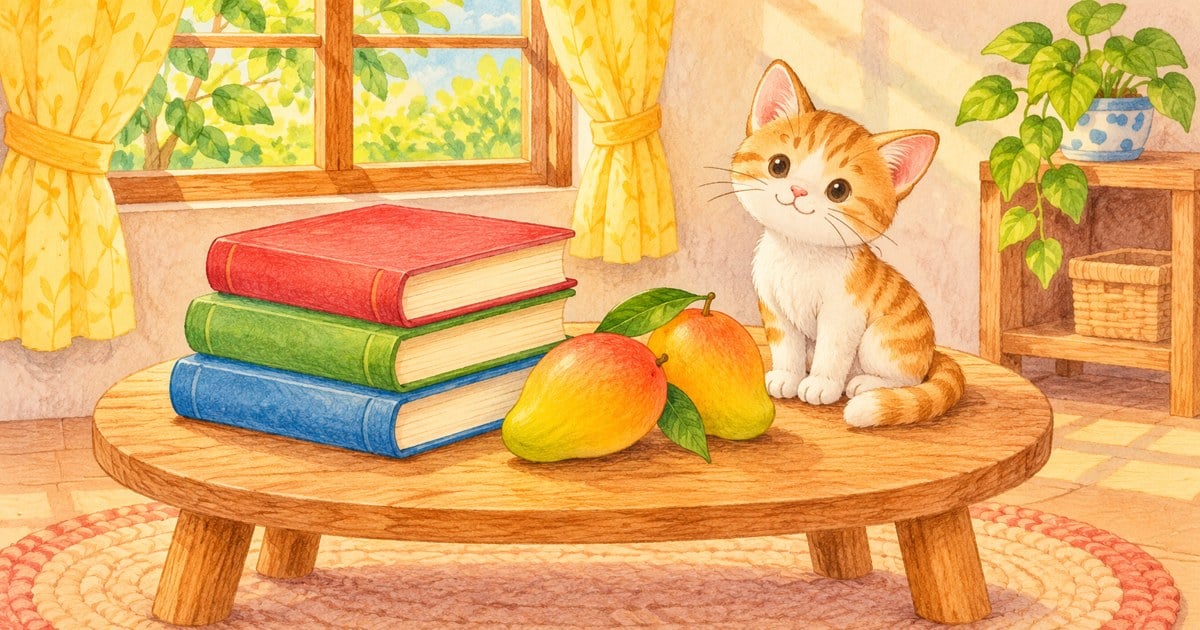
పదాలతో చిన్న వాక్యాలు చేద్దాం.

One book: పుస్తకం. More than one: పుస్తకాలు.
Now make it yours: నా పుస్తకం, my book. In just three small patterns, a vocabulary word becomes something you can use in a conversation.
This lesson covers common noun plurals and possession. We will work with everyday objects first, then explain where the simple patterns need care.
1. Many Telugu plurals use లు
A common plural ending is లు (lu). Sometimes it attaches straightforwardly. Sometimes the noun changes shape too.
| One | Reading aid | More than one | Reading aid | Meaning |
|---|---|---|---|---|
| బొమ్మ | bomma | బొమ్మలు | bommalu | toy / toys |
| పువ్వు | puvvu | పువ్వులు | puvvulu | flower / flowers |
| పుస్తకం | pustakam | పుస్తకాలు | pustakaalu | book / books |
| చెట్టు | chettu | చెట్లు | chetlu | tree / trees |
| ఇల్లు | illu | ఇళ్లు | illu | house / houses |
| పిల్లి | pilli | పిల్లులు | pillulu | cat / cats |
| మనిషి | manishi | మనుషులు | manushulu | person / people |
పూలు (poolu) is another very common plural for flowers. Learn the forms you encounter as complete words.
Do not just stick లు onto everything
Notice what happens to పుస్తకం: the plural is పుస్తకాలు, not a beginner's invented పుస్తకంలు.
In చెట్టు → చెట్లు, the consonant shape changes. In ఇల్లు → ఇళ్లు, ల changes to the curled-back ళ. Our deliberately simple roman spelling writes both as illu; the Telugu letters show a sound difference that the English aid hides.
The table is a starting set, not a complete plural-making algorithm. Learn a new noun with its plural when possible. Some words, including words for substances, are not normally used as simple countable objects in every context.
Our reading aids
We use aa, ee and oo for long vowels. Short and long e/o share simple e/o, so check the Telugu letters. Curled-back and dental consonants sometimes share an English spelling too. The aids help you start; they do not replace the script or listening.
2. Change “this” to “these”
ఇది పుస్తకం.
Idi pustakam.
This is a book.
ఇవి పుస్తకాలు.
Ivi pustakaalu.
These are books.
| Nearby | Farther away |
|---|---|
| ఇది: this thing | అది: that thing |
| ఇవి: these things | అవి: those things |
అవి బొమ్మలు.
Avi bommalu.
Those are toys.
These are object patterns. Telugu uses other choices for people and respectful reference; do not treat this table as the whole pronoun system.
3. My, your and our
Put the possessive word before the noun.
| Telugu | Reading aid | Meaning |
|---|---|---|
| నా | naa | My |
| నీ | nee | Your, familiar singular |
| మీ | mee | Your, respectful singular or plural |
| అతని | atani | His |
| ఆమె | aame | Her |
| మన | mana | Our, including the listener |
| మా | maa | Our, excluding the listener |
| వారి | vaari | Their; also respectful possession |
నా పుస్తకం: my book.
మీ పుస్తకం: your book.
మా ఇల్లు: our house.
Notice that మనం, “we including you,” has the possessive మన. మేము, “we excluding you,” has మా. Do not confuse “my” నా with “our” మా.
One book or several, “my” stays నా
ఇది నా పుస్తకం.
Idi naa pustakam.
This is my book.
ఇవి నా పుస్తకాలు.
Ivi naa pustakaalu.
These are my books.
The noun and the demonstrative changed; నా did not. You do not need a new form of “my” because there are two books instead of one.
A polite question
ఇది మీ పుస్తకమా?
Idi mee pustakamaa?
Is this your book?
అవును. ఇది నా పుస్తకం.
Avunu. Idi naa pustakam.
Yes. This is my book.
With a close friend where familiar address is appropriate, నీ can replace మీ in this question.
4. “My book” and “I have a book” are different patterns
నా పుస్తకం means my book. It is a noun phrase, not by itself the full statement “I have a book.”
For having something, Telugu commonly uses a construction that literally places the thing “to me” or “with me”:
నాకు పుస్తకం ఉంది.
Naaku pustakam undi.
I have a book.
నా దగ్గర పుస్తకం ఉంది.
Naa daggara pustakam undi.
I have a book with me.
The second is especially useful for something you have at hand. Context decides whether the thing belongs to you permanently or is simply in your possession.
| Form | Job |
|---|---|
| నేను | I, as a subject |
| నా | My, before a noun |
| నాకు | To me; used in this “I have” pattern |
Do not swap these at random. Compare నేను చదువుతున్నాను (I am reading), నా పుస్తకం (my book) and నాకు పుస్తకం ఉంది (I have a book).
5. One object is there; several objects are there
For the nonhuman objects in these examples, use ఉంది for singular and ఉన్నాయి for plural.
ఇక్కడ పుస్తకం ఉంది.
Ikkada pustakam undi.
There is a book here.
ఇక్కడ పుస్తకాలు ఉన్నాయి.
Ikkada pustakaalu unnaayi.
There are books here.
నా దగ్గర రెండు పుస్తకాలు ఉన్నాయి.
Naa daggara rendu pustakaalu unnaayi.
I have two books with me.
రెండు means two. Person-counting has its own forms, so do not assume every number expression for objects transfers unchanged to people.
What if there is no book?
నా దగ్గర పుస్తకం లేదు.
Naa daggara pustakam ledu.
I do not have a book with me.
ఇక్కడ పుస్తకాలు లేవు.
Ikkada pustakaalu levu.
There are no books here.
Use లేదు / లేవు for absence in these patterns. కాదు instead denies an identity: ఇది పుస్తకం కాదు, this is not a book. The two negatives do different jobs.
6. Add one describing word
చిన్న బొమ్మ: a small toy.
చిన్న బొమ్మలు: small toys.
పెద్ద ఇల్లు: a big house.
పెద్ద ఇళ్లు: big houses.
In these everyday patterns, చిన్న (chinna, small) and పెద్ద (pedda, big) stay the same before singular and plural nouns. Change the noun, not the describing word.
ఇది నా చిన్న బొమ్మ.
Idi naa chinna bomma.
This is my small toy.
You have combined this + my + small + toy. That is a useful sentence built from small pieces you already understand.
Try it yourself
- Make పుస్తకం plural.
- Say “my books.”
- Complete “These are toys”: ___ బొమ్మలు.
- Choose నా or నాకు: ___ పుస్తకం ఉంది. I have a book.
- Choose ఉంది or ఉన్నాయి: ఇక్కడ పుస్తకాలు ___.
- Say “This is not a book.”
- Which word means “our” including your listener: మన or మా?
Answers
- పుస్తకాలు.
- నా పుస్తకాలు.
- ఇవి బొమ్మలు.
- నాకు పుస్తకం ఉంది.
- ఇక్కడ పుస్తకాలు ఉన్నాయి.
- ఇది పుస్తకం కాదు.
- మన.
Keep these three pairs handy
- పుస్తకం / పుస్తకాలు: book / books.
- నా / నాకు: my / to me, used in the “I have” pattern.
- ఉంది / ఉన్నాయి: singular / plural existence for the objects used here.
Pick three objects near you. Say what each one is, who it belongs to and whether there is one or more than one. A few accurate sentences are better practice than memorising every exception at once.
Grammar reference
For a broader overview, see Features of Telugu Grammar, A V S D S Mahesh, IIT Kanpur. It includes pronouns, case forms and word order. This lesson uses modern beginner-friendly examples rather than reproducing the reference's literary forms.